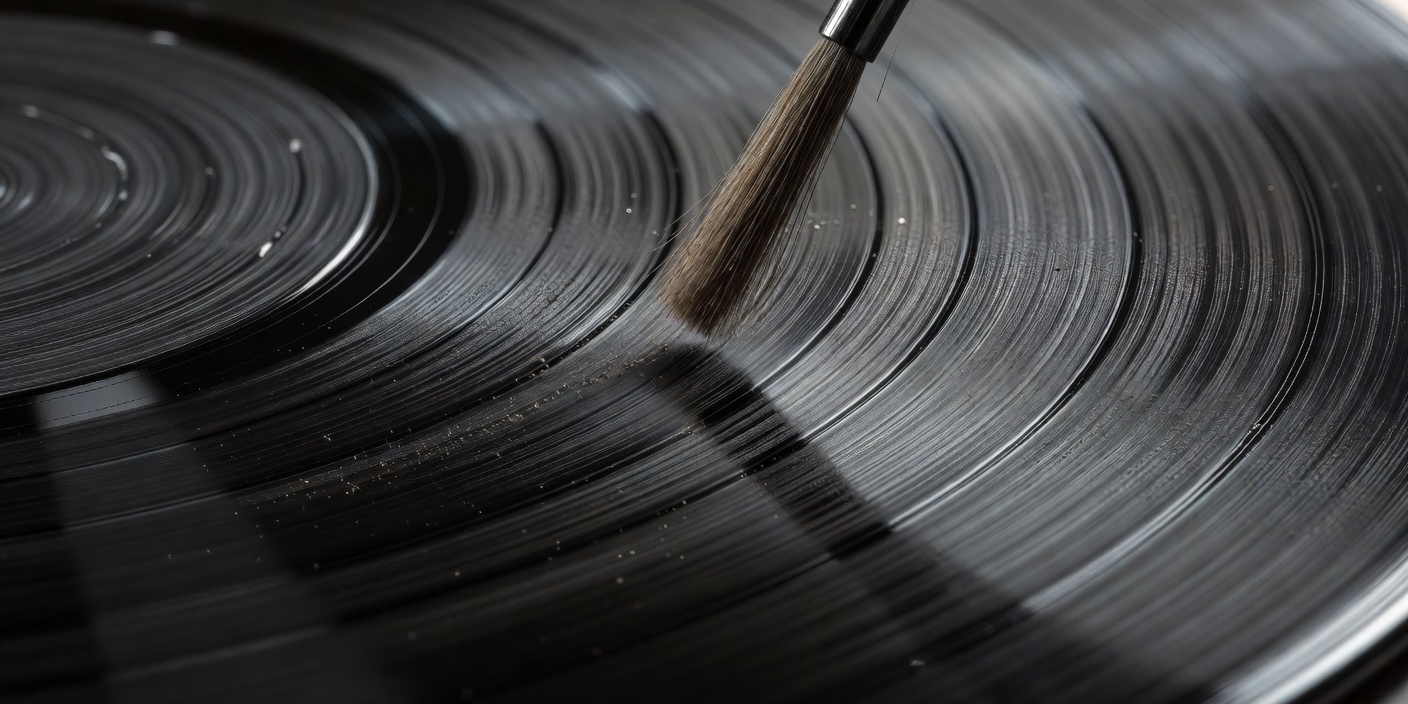
Analog sound fidelity relies on physical contact between a diamond stylus and micro-grooves engraved in polyvinyl chloride. Even microscopic dust particles, fingerprint oils, and static charge degrade playback dynamic range, creating pop, crackle, and surface noise.
1. Daily Dry Cleaning: Carbon Fiber Brushes
Prior to playing any record, static charge must be neutralized and light surface dust removed. A dual-row conductive carbon fiber brush should be held lightly tangential to the spinning record for two full rotations, then slowly swept off the outer edge.
Pro-Tip: Never Use Tap Water
Tap water contains dissolved minerals (calcium, magnesium) that leave white residue inside micro-grooves upon drying. Always use 100% triple-distilled water mixed with isopropyl alcohol and a surfactant (e.g., Tergitol).
2. Deep Wet Washing: Vacuum vs Ultrasonic Cleaning
For pre-owned records dug from crates or records played frequently, dry brushing is insufficient. Deep contamination requires liquid dissolution and cavitation:
- Vacuum Record Cleaning Machines (RCM): Wet fluid is spread over the record surface and sucked away with high vacuum suction, pulling suspended debris out of the groove floor.
- Ultrasonic Cleaners: High-frequency sound waves (40kHz - 120kHz) create microscopic cavitation bubbles in a liquid bath. When these bubbles implode near the record surface, they loosen embedded particulate without abrasive physical rubbing.
3. Sleeve Protection & Archival Storage
Paper inner sleeves leach dust and acid over time. Serious collectors swap original sleeves with anti-static High-Density Polyethylene (HDPE) rice-paper sleeves.
- Store records vertically in a climate-controlled room (65-72°F, 45-50% RH).
- Never stack records horizontally—horizontal pressure causes severe warping.
- Utilize 3 mil poly outer sleeves to preserve jacket spine artwork.